Publication date: 12 November 2024
Author: Luis Damián Moreno García
Here is a brief review of Lara, a new machine translation tool (currently in beta). According to Translated, the company behind Lara, it is a “machine translation system that utilizes the most advanced and state-of-the-art AI technologies to deliver the best and most trustworthy translations to its users.”
More Than Just MT
Lara has been classified as a AI Translation system trained on “25 million real-world translations by top professional translators”, as well as on “machine-generated translations reviewed and refined by professional translators, capturing errors, corrective feedback, and reasoning during disagreements”. This dataset supports its decision-making processes when dealing with wording, phrasing, and tone.
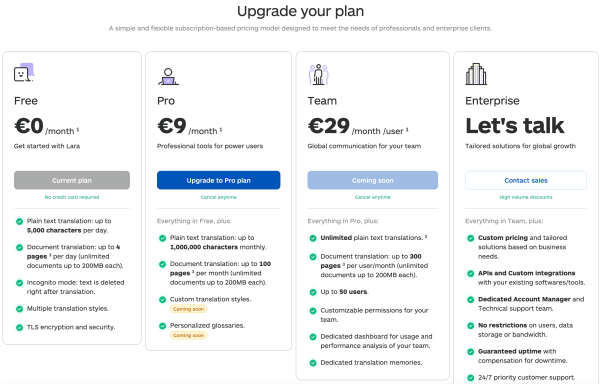
Translated currently offers 4 plans: Free (the one I tested), Pro, Team and Enterprise. The Free plan gives you 5,000 characters per day, the Pro plan 1 million, and the Team plan unlimited quota. The Enterprise plan is devised for company-level use.
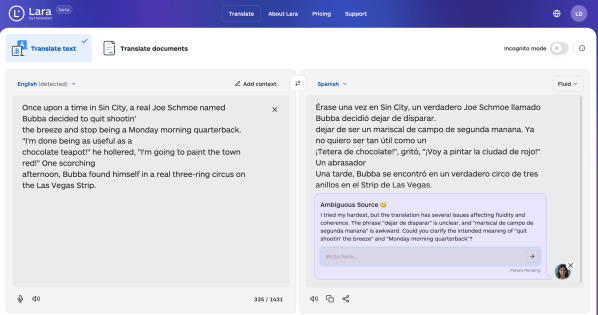
One of the main selling points of Lara is the combination of two tools: machine translation and LLM chatbots. Through a purple textbox under the target text, Lara shares its doubts, explains its choices, asks for clarifications, or just positively asserts itself when it thinks it got the translation right.
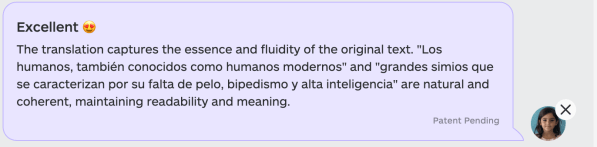
When asked for clarifications, you can provide further explanations that will affect how Lara translates the text. However, it seems that, at the time of writing, if Lara thinks the translation is fine, you will not be able to interact with it.
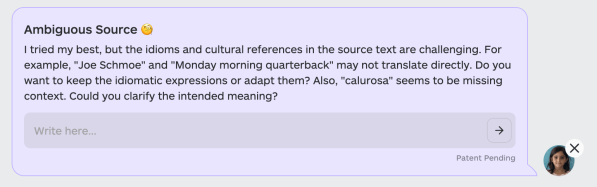
This “translator buddy” approach might greatly increase its appeal. The fact that you can have a conversation with the chatbot means that this is actually an interactive translation assistant, or, as I like to call it, a Prompt-based Conversational Machine Translation system (PCMT).

About Training Data…
Lara offers two modes. The first one is called Learning, where “translation texts are securely stored to improve model quality over time”. This mode will make use of your data to obtain better translations.
The second mode is Incognito (yes, like browsing), where “translation texts are not stored, but quality is static”. The option that you can translate Incognito might attract translators that need to deal with sensitive texts (of course, each translator needs to consider their claims before proceeding).
Context Matters
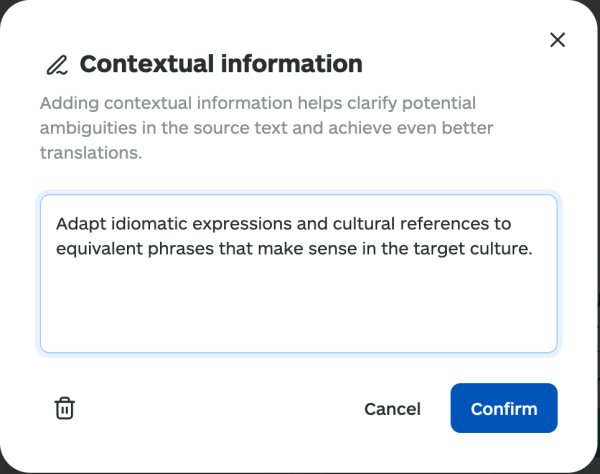
With Lara, you can include Contextual Information, which “helps clarify potential ambiguities in the source text and achieve even better translations.” For example, the first time I pasted a text in the ST box, this information was added automatically: “Adapt idiomatic expressions and cultural references to equivalent phrases that make sense in the target culture.” The system detected that the text included cultural elements and expressions, and guessed that I had this goal in mind (which was in fact the case). Contextual information is, thus, basically an input prompt that guides the model’s behaviour and output.
Different from previous neural machine translation (NMT) approaches, Lara is said to look at the whole document to get a feel for the relationships between sentences.
Document-level translation is what has differentiated machine and human translations up to this point, so this could be a breakthrough. We need research that explores how well (and to what extent) Lara can follow a consistent tone and flow, capture the original intent, link different sections, add layers of natural readability in the TT, etc.
Currently, Lara provides 3 different translation styles:
- Faithful: for precise, technical translations
- Fluid: for general content
- Creative: for more expressive or marketing-focused texts. Beware: output in creative mode might possibly deviate from the ST, even include new meaning.
These modes are similar to how temperature in LLM-based chatbots can be modified to obtain more or less creative translations, and they might follow a similar logic.
Here are the faithful, fluid and creative translations for the same input text. The differences in the output are not obvious in “faithful” and “fluid” modes in the case of this text. However, it is quite obvious that certain elements that were not present in the ST were added in the creative translation, such as “donde el espectáculo no se detenía nunca” (“where the show never stopped”).



This is the Google Translate version for comparison:

Unfortunately, none of the MT versions managed to properly translate or adapt most of the expressions, such as “Sin City”, “Joe Schmoe”, “Monday morning quarterback”, or “paint the town red”, into Spanish.
Human-in-the-loop
Developers know that Lara is not perfect, so they have included the possibility of engaging human experts. For complex requests, cultural nuances, or a final review, professional linguists need to step in and refine the work.
This inclusion is a positive sign from my point of view. Language is nuanced, and humans still play an essential role in ensuring machine translations properly work.
Lara, Tested
In tests, professional translators rated Lara higher than several well-known translation tools, including Google Translate and DeepL, especially for translating user-generated content like reviews or chat messages.

While still far from perfect (and more complex tasks still benefit from human oversight), models like Lara are getting closer to the quality we associate with skilled human translators. The team behind Lara believes that by 2025, it could reach what they call language singularity—a point where AI translations match the accuracy of the best human translators. Verbatim: “By 2025, the new Lara model is expected to match the quality of the top 1% of professional translators in the most widely used language pairs” (https://lara.translated.com/about-lara).
For those of us in the translation industry, including myself, this is a bold claim. I don’t think any given model will totally replace professional translators, especially for complex or nuanced work, or reach the linguistic and cultural acumen of “the top 1% of professional translators” in the near future. However, it will be interesting to see how they progress in this direction, and if they can finally deliver.
Final Thoughts
Lara is a new approach similar to other innovations that have been recently accomplished, like the fine-tuned LLM by Unbabel, TOWER.
Is it going to replace human translators? Not anytime soon. But Lara is an example of what I see as the future of translation: an interface that combines chatbots with more established and reliable translation tools such as translation memories, term bases and QA/LQA.
 Luis Damián Moreno García (PhD, FHEA)
Leave a comment