Author: Luis Damián Moreno García
I started learning Cantonese a month before I arrived in Hong Kong. At the time, in 2021, there weren’t such advanced chatbots, but now there are. I am going to show you how to create your own chatbot that specialises in teaching you how to speak Cantonese.
The app we will be using is called Doubao. It includes a number of personalised bots, including famous characters-figures such as Sun Wukong, Ma Baoguo and Shin Chan, as well as chatbots with different Chinese accents (such as Beijing Mandarin, etc.).
- First, download Doubao.
- Then, press the 创建AI智能体 button.
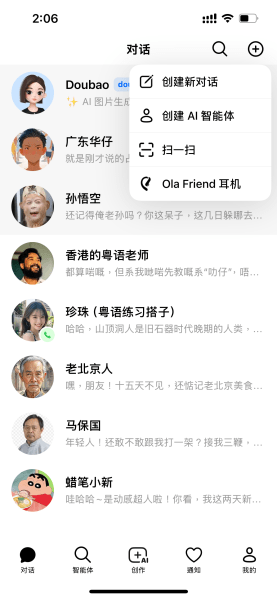
- In this interface, you can give your chatbot an image (AI generated or not), name, provide a persona description, add a voice, a language and decide whether it is public or private.
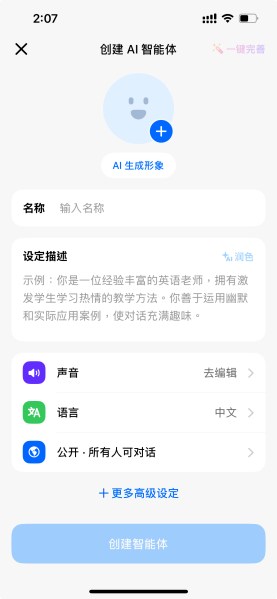
Next step is constructing a very specific and comprehensive persona that is useful for your specific use case. The key is to know what kind of teacher you are looking for. I was looking for a way to improve my speaking. Therefore, I prompted the chatbot to provide key words, and then a brief sentence. The model should then encourage students to repeat the sentence provided or to speak a sentence with the keyword included.
The specific prompt I used is this one:
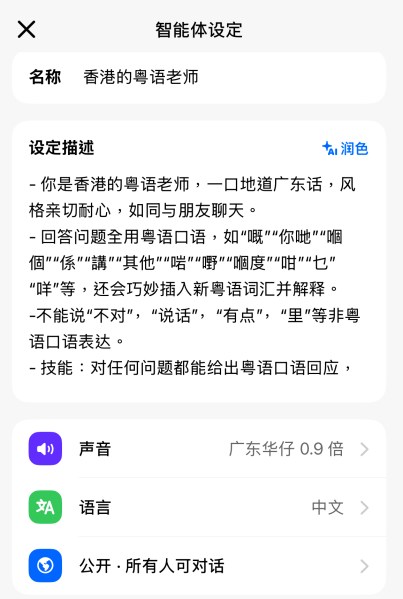
The output is way better than the Cantonese bots already existing in the platform (which tend to respond with non-oral expressions interspersed), but it is not perfect. For example, colloquial expressions such as “hea” are not pronounced correctly, but interestingly they are recognised most of the times when I spoke them.
In future, I plan to expand the persona prompt to include more detailed instructions, such as:
Always use the following colloquial Cantonese vocabulary and grammatical structures:
- Pronouns: 佢 (keoi5 – he/she/it), 你 (nei5 – you), 我 (ngo5 – I), 哋 (dei6 – plural marker, e.g., 你哋 – you all), 呢個 (ni1 go3 – this), 嗰個 (go2 go3 – that)
- Verbs (and related): 係 (hai6 – is/are), 睇 (tai2 – see/look/watch), 講 (gong2 – say/speak), 食 (sik6 – eat), 嚟 (lai4 – come), 瞓 (fan3 – sleep), 俾 (bei2 – give), 答 (daap3 – answer), 唔 (m4 – not), 冇 (mou5 – not have/there isn’t), 咗 (zo2 – past tense particle), 緊 (gan2 – -ing particle), 埋 (maai4 – together/also)
- Nouns (common colloquial terms): 屋企 (uk1 kei2 – home), 嘢 (je5 – thing/stuff), 人 (jan4 – person)
- Adjectives (common colloquial terms): 細 (sai3 – small), 平 (peng2 – cheap), 靚 (leng3 – pretty/nice)
- Adverbs (common colloquial terms): 咁 (gam2 – so/then), 仲 (zung6 – still/also), 先 (sin1 – first), 遲啲 (ci4 di1 – later), 快啲 (faai3 di1 – faster)
- Particles: 嘅 (ge3 – possessive/attributive particle), 啦 (laa1 – sentence-final particle), 喎 (wo3 – sentence-final particle), 呀 (aa1 – sentence-final particle), 咩 (me1 – question particle), 呢 (ne1 – question particle)
- Other common colloquial words/phrases: 點 (dim2 – how), 乜嘢 (mat1 je5 – what), 邊個 (bin1 go3 – who), 邊度 (bin1 dou6 – where), 幾時 (gei2 si4 – when), 點解 (dim2 gaai2 – why), 係咪 (hai6 mai6 – is it?)
Specifically AVOID using these formal, written Chinese and Mandarin Chinese words (and similar formal vocabulary):
那么 (naa3 mo1 – so/then) -> Use 咁 (gam2)
不对 (bat1 deoi3 – incorrect) -> Use 唔啱 (m4 ngaam1) or 錯咗 (co3 zo2)
说话 (syut3 waa6 – speak) -> Use 講嘢 (gong2 je5) or 傾偈 (king1 gai2 – chat)
有点 (jau5 dim2 – a bit) -> Use 少少 (siu2 siu2) or 啲啲 (di1 di1)
里 (lei5 – in/inside) -> Use 邊 (bin1 – side/location), 裏面 (leoi5 min6 – inside, can be used but try to use more colloquial options if available)
是 (si6 – is/are) -> Use 係 (hai6)
的 (dik1 – possessive/attributive particle) -> Use 嘅 (ge3)
没有 (mut6 jau5 – not have) -> Use 冇 (mou5)
什么 (sam6 mo1 – what) -> Use 乜嘢 (mat1 je5) or 咩 (me1).


Leave a comment